
Choosing the best Paper Bags For Restaurants from China requires more than comparing wholesale prices. Restaurant operators need reliable strength, safe materials, accurate dimensions, and consistent production. A bag should carry a hot noodle box without softening, tearing, or staining the customer’s table.
Industry reports support this practical focus. Smithers’ packaging research identifies sustainability, recyclability, and fiber-based formats as major forces shaping foodservice packaging. Grand View Research also reports continued growth in the global paper bags market, driven by retail replacement and consumer preference for paper-based options. These trends create opportunity, but they also create confusion. Some suppliers promote “eco-friendly” claims without explaining recycled content, coatings, or certification details.
Price alone is a poor compass.
A professional sourcing review should examine kraft paper grammage, bag dimensions, bottom construction, handle attachment, printing quality, and moisture resistance. Food-contact documentation should be available for the intended market. Certifications such as FSC chain of custody, ISO 9001, or BRCGS packaging approval may strengthen supplier credibility, but buyers must verify certificate numbers and scope. Samples should be tested with actual restaurant meals, including soup containers, fried foods, and stacked takeaway boxes. A factory may produce attractive samples yet struggle with repeat consistency. That possibility deserves attention. Wholesale buyers should request production records, inspection procedures, lead times, minimum order quantities, and corrective-action policies. This article examines China’s manufacturing advantages, common quality risks, customization options, and practical supplier evaluation methods for restaurants seeking dependable paper bags.
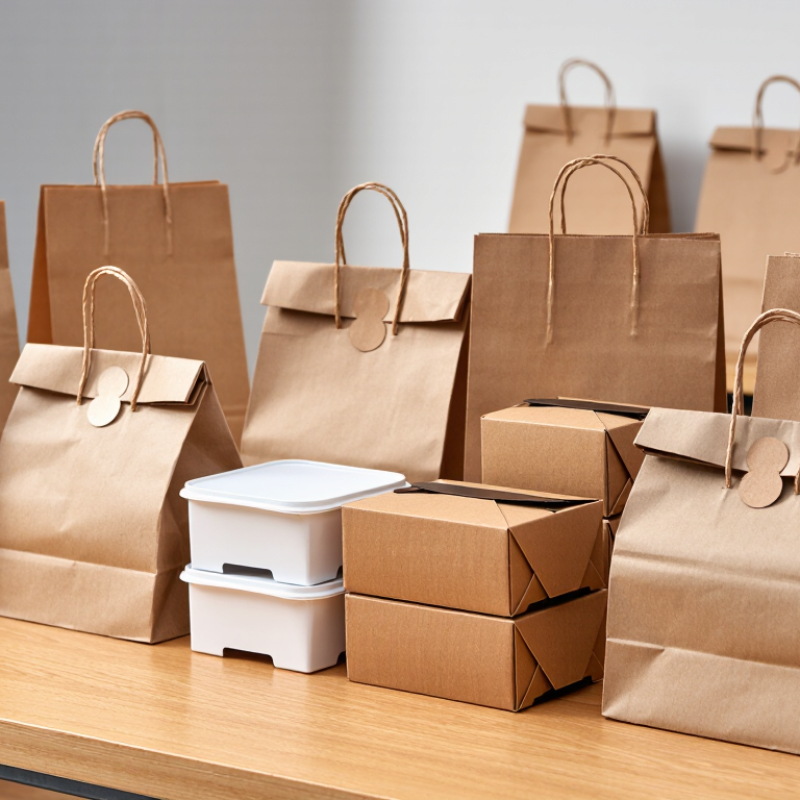
China Restaurant Paper Bag Materials: 40–120 GSM Kraft Paper Options
For restaurant bags, GSM means paper weight per square meter, not automatic strength. In China, 40–60 GSM kraft paper suits light takeaway items, napkins, and small bakery packs. Thin is not always cheap. It may require better folding and handle reinforcement. The FAO FAOSTAT forestry database reports global paper and paperboard production above 400 million metric tonnes in recent years, confirming a mature raw-material supply chain. However, supply volume does not replace incoming quality checks.
A 70–90 GSM kraft bag offers a practical balance for rice boxes, noodle containers, and several drinks. It feels firmer during delivery and resists tearing around the handle area. For heavier meals or damp containers, 100–120 GSM paper gives better stiffness. The paper still needs a suitable moisture barrier. Higher GSM alone cannot prevent oil stains or weakened seams. ISO 536 defines grammage testing, while ISO 1974 supports tear-resistance evaluation; buyers should request test results using these recognized methods.
The Smithers report, The Future of Sustainable Packaging to 2028, identifies paper-based packaging as a major growth area linked to fiber-based alternatives and recycling goals. That trend matters, but restaurant buyers should inspect real samples. Test a filled bag for 30 minutes. Check the base, folded corners, and handle attachment. I have seen attractive samples fail after condensation exposure. A better specification lists GSM, paper grade, recycled content, moisture performance, dimensions, and load-testing conditions. This prevents a low quoted price from hiding costly replacements.
Kraft paper bags for restaurants are commonly specified by paper weight. GSM means grams per square meter: a higher GSM generally indicates a thicker and more rigid paper sheet.
How to read the chart: 40–60 GSM options are lightweight and suited to small takeaway items, while 80–120 GSM options provide more structure for heavier meals, multiple containers, and larger restaurant bags. Actual bag performance also depends on paper quality, moisture exposure, bag dimensions, handles, and construction.
Choosing China-made paper bags for restaurant wholesale requires more than checking price, kraft color, or printing quality. Food-contact compliance must match the bag’s real use. A bag for dry bread differs from one holding hot, oily fried food. Ask for the paper grade, recycled content information, ink details, adhesive specifications, and intended temperature limits.
For the United States, FDA 21 CFR compliance depends on every substance that may contact food. The paper, coatings, inks, and adhesives should have suitable regulatory support for their intended conditions. A certificate alone is not enough. Review supplier declarations, laboratory reports, and migration or extractive testing when necessary. Test samples with hot meals, oil, and moisture. Small failures often appear at the glued seams.
In the European Union, Regulation (EC) No 1935/2004 requires food-contact materials to avoid harmful transfer and unacceptable changes to food. Traceability is also essential throughout wholesale production. Request documentation linking each batch to its raw materials and manufacturing records. Good manufacturing practices matter in daily operations, not only during audits. EU paper rules can be less straightforward than plastic rules, so professional review may be needed. Some documents look complete but lack test conditions. That deserves a second question. Suppliers should explain limits clearly, even when the answer is inconvenient.
When restaurants buy paper bags wholesale, appearance is only one part of quality. Grammage deserves measured attention. ISO 536 determines the paper’s mass per square metre, usually reported in grams per square metre. A controlled sample is conditioned before weighing, because humidity can change paper weight and handling performance. Small differences matter.
A reliable inspection team should sample bags from different cartons, not just the top layer. The test area must be clean, the balance calibrated, and records linked to the production batch. Higher grammage may improve stiffness, but it can also increase shipping cost. More paper is not automatically better. That point is easy to miss.
ISO 12048 examines compression resistance for complete, filled transport packages. For restaurant bags, the test setup should reflect actual use, including the intended contents, filling level, closure, and stacking direction. Inspectors can record maximum load, deformation, and failure time. A bag that survives a short laboratory test may still weaken after moisture exposure or repeated handling. This is where practical experience matters.
Paper bags are not always tested under realistic restaurant conditions. Hot food containers, condensation, and uneven loading can produce results that a dry laboratory test cannot fully represent. Buyers should compare test reports, sampling plans, and acceptance limits instead of trusting a single number. Clear records make supplier discussions more objective and help identify whether a failure comes from paper, construction, or handling.
China Best Paper Bags for Restaurants Wholesale?
The EPA reports a 68.2% U.S. paper and paperboard recycling rate. This figure comes from its Facts and Figures report, based on 2018 national data. More recently, the American Forest & Paper Association reported 60.7% paper recovery in 2023. These figures show strong recycling performance, but they do not make every restaurant bag automatically sustainable.
For wholesale buyers, bag specifications matter. Choose unbleached or lightly printed paper, water-based inks, and responsibly sourced fiber. A 60–70 GSM bag may suit pastries, while heavier 90–120 GSM paper handles takeaway meals better. Flat handles can reduce material use, but twisted handles often improve carrying comfort. In real restaurant operations, grease and moisture create problems. A clean paper bag may be recyclable, while a heavily contaminated one may be rejected by local facilities. That detail is easy to overlook.
Tips: Ask suppliers for recycled content information, fiber certifications, GSM data, and test samples. Check whether coatings separate easily during pulping. Confirm local recycling guidance before printing disposal instructions. Do not rely on the EPA percentage alone. It measures national recovery, not the fate of every individual bag. I have seen attractive packaging fail in practice because handles tear, bottoms soften, or recycling instructions remain unclear. That is where sustainability claims need more careful testing.
| Benchmark Dimension | U.S. Data | Unit / Basis | Wholesale Relevance | Source / Year |
|---|---|---|---|---|
| Paper and paperboard generated | 67.4 million | Short tons | Shows the scale of the U.S. paper material stream relevant to paper food packaging. | U.S. EPA, 2018 |
| Paper and paperboard recycled | 46.6 million | Short tons | Supports specifying recyclable paper bags and clear disposal guidance for customers. | U.S. EPA, 2018 |
| Paper recycling rate | 68.2% | Recycled ÷ generated | A national sustainability benchmark for evaluating paper-based restaurant packaging. | U.S. EPA, 2018 |
| Paper and paperboard sent to landfills | 16.5 million | Short tons | Highlights the importance of reducing contamination from food residue, liquids, and coatings. | U.S. EPA, 2018 |
| Paper and paperboard combusted with energy recovery | 4.3 million | Short tons | Indicates that end-of-life outcomes vary by local waste-management infrastructure. | U.S. EPA, 2018 |
| Recycled-content documentation | Postconsumer percentage should be stated separately | Procurement specification | Request supplier documentation distinguishing recycled content from pre-consumer fiber. | FTC Green Guides; supplier declaration |
| Food-contact compliance | Must be verified for the intended use | Material and coating documentation | Ask for food-contact declarations, especially when bags touch food directly or contain greasy products. | U.S. FDA food-contact requirements |
| Recyclability claim | Dependent on local collection and sorting systems | End-of-life condition | Confirm that the bag structure, handles, inks, coatings, and food residue are compatible with the target market’s recycling system. | U.S. EPA; local recycling guidance |
Note: The 68.2% figure is the U.S. EPA’s 2018 recycling rate for the combined paper and paperboard material category; it is not a recycling rate for restaurant bags alone.
Restaurant wholesalers often call paper bags “compostable” too quickly. EN 13432 sets measurable conditions. A certified product must achieve at least 90% biodegradation within six months under controlled industrial composting. It must also disintegrate sufficiently within twelve weeks. These tests use defined temperature, moisture, oxygen, and microbial conditions.
A paper bag may contain a thin barrier, adhesive, ink, or handle material. Each component can affect certification. Industrial composting facilities usually operate near 58°C, while home compost piles vary widely. A bag that breaks down in one test may remain visible beside a cool backyard pile. Buyers should request test reports, certificate scope, and batch traceability, not only a printed claim.
Market demand is expanding. European Bioplastics reported global bioplastics production capacity at about 2.47 million tonnes in 2024, with capacity projected to exceed 5.7 million tonnes by 2029. However, the Ellen MacArthur Foundation’s 2023 progress report showed that packaging systems still face limited collection and recycling infrastructure. Compostable packaging has a similar weakness: certification does not guarantee local processing.
For wholesale restaurant orders, specify the required bag size, load strength, food-contact compliance, and disposal route. Ask whether the entire bag, including handles and coatings, meets EN 13432. Small details matter. I have seen “compostable” wording treated as a shortcut, when it should be a documented performance claim.
GSM means grams per square metre, measuring paper weight. It does not automatically prove bag strength. Weight alone proves little.
40–60 GSM kraft paper suits napkins, small bakery packs, and light takeaway items. Thin paper needs accurate folding. Handle reinforcement may still be necessary.
70–90 GSM usually balances stiffness, cost, and carrying comfort. It suits rice boxes, noodle containers, and several drinks. Actual performance can vary.
Choose 100–120 GSM for heavier meals or damp containers. The thicker paper feels firmer during delivery. It still needs suitable moisture protection.
No. Higher GSM alone cannot stop oil stains or weakened seams. A suitable moisture barrier is important. Thicker is not magic.
Use samples from different cartons, not only the top layer. Check grammage with a calibrated balance. Record the production batch and test conditions.
Fill the bag with real meal containers and drinks. Test it for about 30 minutes. Inspect the base, folded corners, and handle attachments.
Hot food creates condensation inside the bag. Moisture can weaken seams and paper fibers. A dry laboratory result may miss this problem.
List GSM, paper grade, recycled content, dimensions, and moisture performance. Include load limits, filling levels, and stacking conditions. Otherwise, price comparisons become misleading.
No. Compression testing shows performance under defined conditions. Uneven loading and repeated handling may cause different failures. Real use remains imperfect.
Choosing the right Paper Bags For Restaurants requires balancing material performance, food safety, sustainability, and wholesale value. Kraft paper between 40 and 120 GSM can support different applications, from lightweight takeaway items to stronger meal packaging. Buyers should request food-contact documentation aligned with FDA 21 CFR and EU Regulation 1935/2004, while also confirming consistent production quality through tests such as ISO 536 for grammage and ISO 12048 for compression strength.
Sustainability is another important consideration. Paper recycling performance can be evaluated against reliable environmental benchmarks, including the reported 68.2% U.S. paper recycling rate. If bags are marketed as compostable, suppliers should provide evidence that the materials meet recognized requirements such as EN 13432, including 90% biodegradation within six months under specified testing conditions. A careful review of specifications, certifications, printing quality, handle strength, and packaging efficiency can help restaurants select dependable bags for wholesale purchasing.
